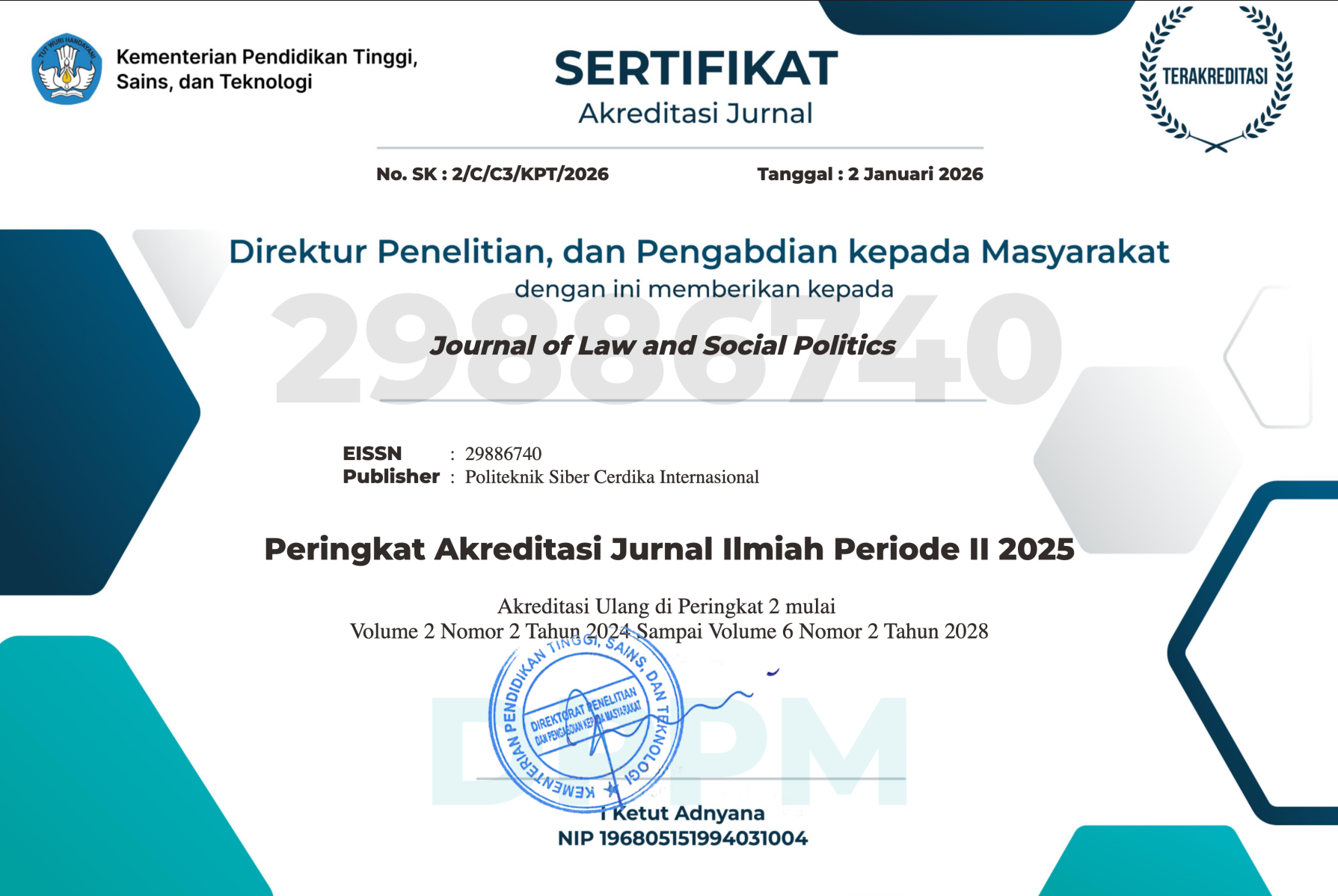
A Normative Critique of the Legal Status of Lecturers in Private Higher Education Institutions in Indonesia
DOI:
https://doi.org/10.59261/jlsp.v4i4.157Abstract
Background: The legal relationship between lecturers and private higher education institutions (PTS) in Indonesia remains normatively problematic because it is regulated under a labor-law framework, despite lecturers’ status as professional educators who carry out the Tridharma of Higher Education.
Objective: This article aims to critically analyze the applicability of labor law in regulating lecturer-PTS legal relationships and to formulate an alternative legal framework that reflects lecturers’ professional characteristics.
Methods: This study uses normative legal research with statutory, conceptual, and normative-critical approaches. Legal materials consisting of primary, secondary, and tertiary sources were analyzed through qualitative-prescriptive methods to examine the consistency between labor law and higher education regulations.
Results: The findings reveal that the application of labor law creates fundamental contradictions in lecturer-PTS relationships. The elements of work, wages, and authority (gezagsverhouding) under Law No. 13 of 2003 are inconsistent with lecturers’ professional autonomy and academic freedom guaranteed by Law No. 14 of 2005 and Law No. 12 of 2012. This contradiction affects the protection of academic rights, dispute-resolution certainty, and professional independence. Therefore, this article proposes an alternative framework based on equality, professional autonomy, special protection, and a specific dispute-resolution mechanism.
Conclusion: The lecturer-PTS legal relationship should be constructed as a specific academic-professional relationship (sui generis) that emphasizes parity between lecturers and institutions, rather than a subordinate industrial employment relationship. This framework provides a more appropriate legal basis for protecting academic professionalism and institutional governance.
References
Abas, M. (2025). Comparison of Indonesian private lecturer wage systems with the Netherlands from Jhon Rawls' legal perspective. SASI, 31(1), 16–32. https://doi.org/10.47268/sasi.v31i1.2261
Cahyono, D. J. P., & Wahyono, D. (2017). Penyelesaian perselisihan antara badan penyelenggara perguruan tinggi swasta dengan dosen. Mimbar Keadilan, 20–44.
Candra, A., Sitohang, B. A., & Muban, A. (2025). Kritik hukum formal terhadap filsafat hukum. Nusantara: Jurnal Pendidikan, Seni, Sains dan Sosial Humaniora, 3(1).
Christiana, I. (2024). Otonomi Perguruan Tinggi Negeri dalam Perspektif Pemikiran Pendidikan Kritis Henry Giroux (Doctoral dissertation, Universitas Gadjah Mada). https://doi.org/10.13140/RG.2.2.26471.46240
Dhaniarti, I. (2015). Karakteristik hubungan hukum antara badan penyelenggara pendidikan tinggi dengan dosen swasta. E-Jurnal The Spirit of Law, 1(1). https://doi.org/10.33121/tsl.v1i1.32
Disemadi, H. S. (2022). Lenses of legal research: A descriptive essay on legal research methodologies. Journal of Judicial Review, 24(2), 289–304. https://doi.org/10.37253/jjr.v24i2.7280
Dwiarnanto, A. (2020). Perlindungan honorarium terhadap tenaga pengajar/dosen yang mengajar di perguruan tinggi swasta menurut UU No. 13 Tahun 2003. Akrab Juara: Jurnal Ilmu-Ilmu Sosial, 6(1), 31–41.
Elwan, A. (2022). Peran yayasan dalam aras kewenangan untuk mewujudkan tata kelola perguruan tinggi swasta yang baik (good university governance). Jurnal Administrasi Publik dan Pemerintahan, 1(2), 67–79. https://doi.org/10.55850/simbol.v1i2.14
Farikhah, M. (2018). Rekonseptualisasi judicial pardon dalam sistem hukum Indonesia (studi perbandingan sistem hukum Indonesia dengan sistem hukum Barat). Jurnal Hukum & Pembangunan, 48(3), 556–588. https://doi.org/10.21143/jhp.vol48.no3.1746
Gaffar, S., Karsona, A. M., Pujiwati, Y., & Perwira, I. (2021). The concept of procedural law regarding the implementation of collective agreements with legal certainty in termination of employment in Indonesia. Heliyon, 7(4). https://doi.org/10.1016/j.heliyon.2021.e06690
Hartanto, C. F. B., & Haryani, H. (2020). Analisis tata kelola standar pendidik dan tenaga kependidikan pada pendidikan tinggi vokasi kemaritiman di Indonesia. Jurnal Sains Teknologi Transportasi Maritim, 2(1), 20–29. https://doi.org/10.51578/j.sitektransmar.v2i1.14
Huda, M. (2017). Keadilan dalam hubungan hukum antara dosen perguruan tinggi swasta dengan badan. Yuridika, 32(3), 464–490. https://e-journal.unair.ac.id/YDK/article/download/4852/3683
Ibrahim, J. (2013). Teori & metodologi penelitian hukum normatif. Bayumedia Publishing.
Idrus, A., Abidin, D., Saputra, N., Rahman, A., & Shobri, M. (2022). Implementation of Minister of Education and Culture policy number 84 of 2013 article 11. Munaddhomah: Jurnal Manajemen Pendidikan Islam, 3(2), 175–182. https://doi.org/10.31538/munaddhomah.v3i2.248
Irianto, S. (2012). Otonomi perguruan tinggi: Suatu keniscayaan. Yayasan Pustaka Obor Indonesia.
Izzati, N. R. (2020). Penerapan doktrin penyalahgunaan keadaan (undue influence) sebagai alasan pembatalan perjanjian kerja di Pengadilan Hubungan Industrial. Masalah-Masalah Hukum, 49(2), 180–191. https://doi.org/10.14710/mmh.49.2.2020.180-191
Mahardian, A., Nizam, A. R., Hasani, A. R., & Fadhil, M. (2019). Tinjauan yuridis mengenai aturan hukum pemutusan hubungan kerja terhadap dosen perguruan tinggi swasta. Perspektif Hukum, 19(2), 307–324. https://doi.org/10.30649/ph.v19i2.121
Maisah, M. (2016). Kemampuan manajerial dalam pemberdayaan dosen perempuan (studi gender pada STAI Yasni Kabupaten Muara Bungo, STAI Syekh Maulana Qori Kabupaten Merangin, dan STAI An-Nadwah Kabupaten Kuala Tungkal di lingkungan wilayah Kopertais XIII Provinsi Jambi). Gender Equality: International Journal of Child and Gender Studies, 2(1), 87–100.
Maya, Y., Putri, R. W., Tristiyanto, & Davey, O. M. (2023). Toward the legal aspect on developing academics intellectual property rights in university. 17–29. https://doi.org/10.2991/978-2-38476-046-6_3
Nita, S. (2017). The legal position of lecturer at university which incorporated as foundation in Indonesia. Yustisia Jurnal Hukum, 5(3). https://doi.org/10.20961/yustisia.v5i3.8810
Nurpratama, M., Yudianto, A., & Firdaus, T. (2024). Pengembangan yayasan perguruan tinggi swasta membentuk badan layanan kegiatan usaha. Jurnal Investasi, 10(1), 1–7. https://doi.org/10.31943/investasi.v10i1.297
Nursalim, C. R. P., & Suryono, L. J. (2020). Perlindungan hukum tenaga kerja pada perjanjian kerja outsourcing. Media of Law and Sharia, 2(1), 46–62. https://doi.org/10.18196/mls.v2i1.11478
Rahmawati, R., & Saputra, J. (2022). The implementation of the independent learning campus policy: Private universities dilemma. Journal of Madani Society, 1(2), 112–120. https://doi.org/10.56225/jmsc.v1i2.134
Rohanawati, A. N. (2021). Jaminan sosial tenaga kerja di Indonesia sebagai negara kesejahteraan ditinjau dari perspektif hukum progresif. Fiat Justisia Jurnal Ilmu Hukum, 15(2). https://doi.org/10.25041/fiatjustisia.v15no2
Roulina, C. G., & Nugroho, A. A. (n.d.). Implikasi kebijakan pemberian uang saku dengan ketidakpastian jam kerja magang berdasarkan perspektif hukum ketenagakerjaan. Jurnal USM Law Review, 7(3), 2006–2026. https://doi.org/10.26623/julr.v7i3.10980
Santina, R., Suparno, S., & Riswadi, R. (2023). Legal protection for lecturers in running their professions as educators in higher education. https://doi.org/10.4108/eai.12-11-2022.2327285
Serfiyani, C. Y. (2020). Restrukturisasi perguruan tinggi swasta sebagai upaya penyehatan dan peningkatan kualitas institusi. Jurnal Hukum Ius Quia Iustum, 27(2). https://doi.org/10.20885/iustum.vol27.iss2.art10
Sulaksono, S. (2017). Regulation authority toward management and conflict resolution on private higher education. IOSR Journal of Research & Method in Education (IOSR-JRME), 7(2), 80–85. https://doi.org/10.9790/7388-0702038085
Tan, D. (2021). Metode penelitian hukum: Mengupas dan mengulas metodologi dalam menyelenggarakan penelitian hukum. Nusantara: Jurnal Ilmu Pengetahuan Sosial, 8(8), 2463–2478.
Thoha, M. (2018). Strategi peningkatan nilai-nilai kecerdasan emosional dalam pengelolaan (manajemen) sumber daya manusia di perguruan tinggi keagamaan Islam. Nuansa: Jurnal Penelitian Ilmu Sosial dan Keagamaan Islam, 15(2), 365–392. https://doi.org/10.19105/nuansa.v15i2.2063
Turnip, J. M. (2016). Perlindungan hukum terhadap dosen perguruan tinggi swasta yang di-PHK. Universitas Sumatera Utara.
Waltham-Smith, N., & Murray, J. (2024). Academic freedom and protected philosophical belief: Strengthening the legal analysis. Industrial Law Journal, 53(4), 711–745. https://doi.org/10.1093/indlaw/dwae038
Wartoyo, F. X., & Prasetyo, T. (2023). Legal protection and welfare in education: A post-pandemic recovery perspective on implementing Law No. 14 of 2005. Jurnal Pembaharuan Hukum, 10(3), 541. https://doi.org/10.26532/jph.v10i3.36117
Wibowo, R. J. A. (2023). Urgensi pembaharuan hukum ketenagakerjaan Indonesia untuk mengakomodasi perlindungan hubungan kemitraan. Jurnal Ketenagakerjaan, 18(2), 109–123.
Yeltriana, Y., Batubara, I., & Kausar, A. R. (2023). The position of private lecturers in higher education in the perspective of labor law. Attasyrih, 9(1), 69–79. https://doi.org/10.55849/attasyrih.v9i1.160
Yudhi, R., & Prastyo, A. B. (2020). Recruitment of law faculty lecturers and the implications of output graduates in the manpower sector. Progressive Law Review, 2(2), 57–68. https://doi.org/10.36448/plr.v2i02.34
Downloads
Published
How to Cite
Issue
Section
License
Copyright (c) 2026 Febri Jaya, Ampuan Situmeang, Nurlaily, Albert Kho

This work is licensed under a Creative Commons Attribution-ShareAlike 4.0 International License.